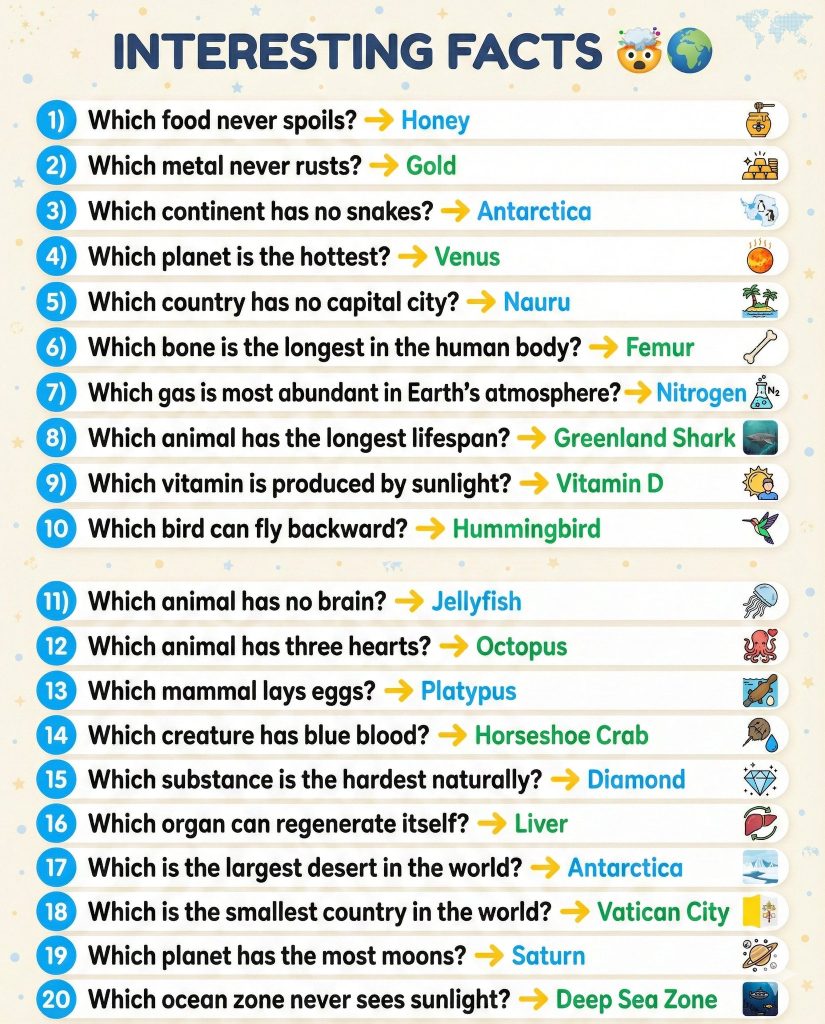
Interesting Facts every Nigerian should know
Expanding Your Knowledge: Interesting Facts Every Nigerian Should Know
In Nigeria, we value wisdom and “brain-power.” Whether you are a student preparing for a quiz, a professional looking for interesting conversation starters at a Lagos boardroom, or just a curious mind sitting in traffic on the Third Mainland Bridge, knowing more about the world around us is always an advantage.
We live in a world filled with mysteries that often defy common sense. While we are used to the heat of the Nigerian sun and the richness of our local jollof, there are global truths that are even more surprising. This blog post breaks down twenty incredible facts that cover science, geography, and biology, tailored for the curious Nigerian mind.
The Wonders of Nature and Science
Science often provides answers to things we take for granted. Some substances on Earth seem to defy the laws of decay, while others possess strengths that are almost supernatural.
1. The Eternal Food: Honey
In many Nigerian households, we are used to checking “best before” dates on canned milk or bags of rice. However, did you know that honey is the only food that truly never spoils? Archaeologists have actually found pots of honey in ancient Egyptian tombs that are over 3,000 years old and—believe it or not—are still perfectly edible. Because of its low moisture content and acidic pH, bacteria cannot survive in it. So, if you have a jar of pure, undiluted honey in your cupboard, it will likely outlive you!
2. The Metal That Never Rusts: Gold
We all know how frustrating it is when a gate or a car part starts to “brown” because of the humidity in places like Port Harcourt or Lagos. That is oxidation, commonly known as rust. However, gold is a noble metal, meaning it does not react with oxygen. You could bury a gold coin in the mud for a century, and when you dig it up and wash it, it will shine just as brightly as the day it was made. This is why it remains one of the most valuable substances in the world.
3. The Hardest Natural Substance: Diamond
While we often think of steel as being incredibly strong, the title for the hardest naturally occurring substance belongs to the diamond. Formed deep within the Earth under intense heat and pressure, diamonds are so hard that the only thing capable of scratching a diamond is another diamond. In the industrial world, they aren’t just for jewelry; they are used on the tips of heavy-duty drills to cut through rock and metal.
Geographic Anomalies You Should Know
Geography is more than just knowing the capitals of states in Nigeria. It involves understanding the unique layouts of our planet and the places that break the rules.
4. The Continent With No Snakes: Antarctica
If you have a phobia of snakes, Antarctica is the safest place on Earth for you. Every other continent in the world—Africa, Asia, Europe, North and South America, and Australia—is home to various species of snakes. But the freezing temperatures of Antarctica make it impossible for cold-blooded reptiles to survive. In Nigeria, we may deal with the occasional cobra or viper, but at the South Pole, the only thing you have to worry about is the ice.
5. The Country With No Capital City: Nauru
We are used to Abuja being the center of power in Nigeria, just as London is for the UK or Washington D.C. is for the US. However, the tiny island nation of Nauru in the Pacific Ocean is the only country in the world without an official capital city. While it has a government district called Yaren, it doesn’t hold the formal title of “Capital.”
6. The World’s Largest Desert: Antarctica
This fact often shocks people. When we hear the word “desert,” we immediately think of the Sahara and its burning sands. However, in geography, a desert is defined by how much precipitation (rain or snow) it receives, not by its temperature. Because Antarctica receives very little moisture, it is technically the largest desert in the world, far surpassing the Sahara in size.
7. The Smallest Country: Vatican City
While Nigeria is a giant in terms of population and landmass, Vatican City is the exact opposite. Located entirely within the city of Rome, Italy, it is the smallest independent state in the world, both by area and population. It covers only about 44 hectares of land. To put that in perspective, many large estates in Lekki or estates in Abuja are bigger than this entire country!
Incredible Secrets of the Human Body
Our bodies are complex machines, and even though we live in them every day, there are things they can do that feel like science fiction.
8. The Longest Bone: The Femur
The human skeleton is a masterpiece of engineering. The longest and strongest bone in your body is the femur, also known as the thigh bone. It supports the weight of your body and is even stronger than concrete when it comes to supporting weight. This is why it takes a very high-impact force to break it.
9. The Organ That Can Regenerate: The Liver
Most organs, once damaged, stay damaged or form scar tissue. However, the liver is unique. It is the only internal organ capable of natural regeneration of lost tissue. In fact, if a person has as little as 25% of their liver remaining, it can grow back to its full size and function within a relatively short period. This is why liver transplants are possible using only a portion of a donor’s liver.
10. The Sunlight Vitamin: Vitamin D
In Nigeria, we are blessed with abundant sunshine almost year-round. This is great news for our health because our bodies produce Vitamin D when our skin is exposed to UV rays. Unlike other vitamins that we must get from food, Vitamin D is actually a hormone produced by the body. It is essential for bone health and immune function, which is why “catching some sun” is more than just a phrase—it’s a biological necessity.
The Wonders of the Animal Kingdom
Animals have evolved incredible traits to survive in their specific environments. Some of these traits seem almost alien to us.
11. The Animal With Three Hearts: The Octopus
While humans get by just fine with one heart, the octopus requires three. Two of the hearts work specifically to pump blood to the gills, while the third pumps it to the rest of the body. Interestingly, when an octopus swims, the heart that delivers blood to the organs actually stops beating, which is why they prefer crawling over swimming—it’s less exhausting!
12. The Bird That Flies Backward: The Hummingbird
Most birds can only fly forward or glide, but the hummingbird is a marvel of avian engineering. It is the only bird capable of flying backward and even upside down. Their wings can beat up to 80 times per second, allowing them to hover in place while they feed on flower nectar.
13. The Mammal That Lays Eggs: The Platypus
We are taught in school that mammals give birth to live young, while birds and reptiles lay eggs. The Platypus, found in Australia, breaks all these rules. It is a mammal (it has fur and produces milk), yet it lays eggs. It is one of the few “monotremes” left on Earth, reminding us that nature doesn’t always follow a strict script.
14. Blue Blood: The Horseshoe Crab
In Nigeria, we know blood is red. However, the Horseshoe Crab has bright blue blood. This is because their blood is copper-based, unlike human blood which is iron-based (hemoglobin). Their blood is also incredibly valuable to modern medicine because it contains a special substance used to test if medical equipment and vaccines are free of bacteria.
15. The Brainless Wonder: The Jellyfish
It is hard to imagine living without a brain, but the jellyfish has been doing it for millions of years. They have no brain, no heart, and no bones. Instead, they have a “nerve net” that allows them to sense light, touch, and chemicals in the water. They are a testament to the fact that you don’t need a complex central nervous system to survive in the ocean.
Space and the Atmosphere
Looking up at the sky at night, we see a vast expanse that holds many secrets. Even the air we breathe isn’t quite what we think it is.
16. The Hottest Planet: Venus
Many people assume Mercury is the hottest planet because it is closest to the sun. However, Venus holds the title. Because of its thick atmosphere, it traps heat in a “runaway greenhouse effect,” making its surface temperature hot enough to melt lead—about 462°C.
17. The Most Abundant Gas: Nitrogen
We often think the air is mostly oxygen because that is what we need to breathe. In reality, oxygen only makes up about 21% of Earth’s atmosphere. The vast majority—about 78%—is actually Nitrogen. Nitrogen is crucial because it dilutes the oxygen and prevents the Earth’s surface from becoming highly flammable.
18. The Planet With the Most Moons: Saturn
For a long time, Jupiter was the king of moons. However, recent discoveries have shown that Saturn actually has the most moons in our solar system, with 146 confirmed moons. These range from tiny moonlets to the massive Titan, which is larger than the planet Mercury.
Life in the Deep and the Long
Finally, let’s look at the extremes of lifespan and the depths of the ocean.
19. The Longest Lifespan: The Greenland Shark
While humans celebrate reaching 100 years, the Greenland shark is just getting started at that age. These sharks are the longest-living vertebrates on the planet, with some estimated to live between 250 and 500 years. They live in the cold waters of the North Atlantic and grow very slowly, which contributes to their incredible longevity.
20. The Eternal Darkness: The Deep Sea Zone
Below a certain depth in the ocean, known as the “Midnight Zone” or the Aphotic Zone, sunlight never reaches. It is a world of total darkness, extreme cold, and immense pressure. The creatures that live there often create their own light through bioluminescence. It is a reminder that even on our own planet, there are places that are as alien and unexplored as outer space.
Knowledge is power, and staying informed about these global facts helps us appreciate the complexity of the world we live in. Which of these facts surprised you the most?